Where are the chest protectors for big breasts?
It's not like we're new to the sport...

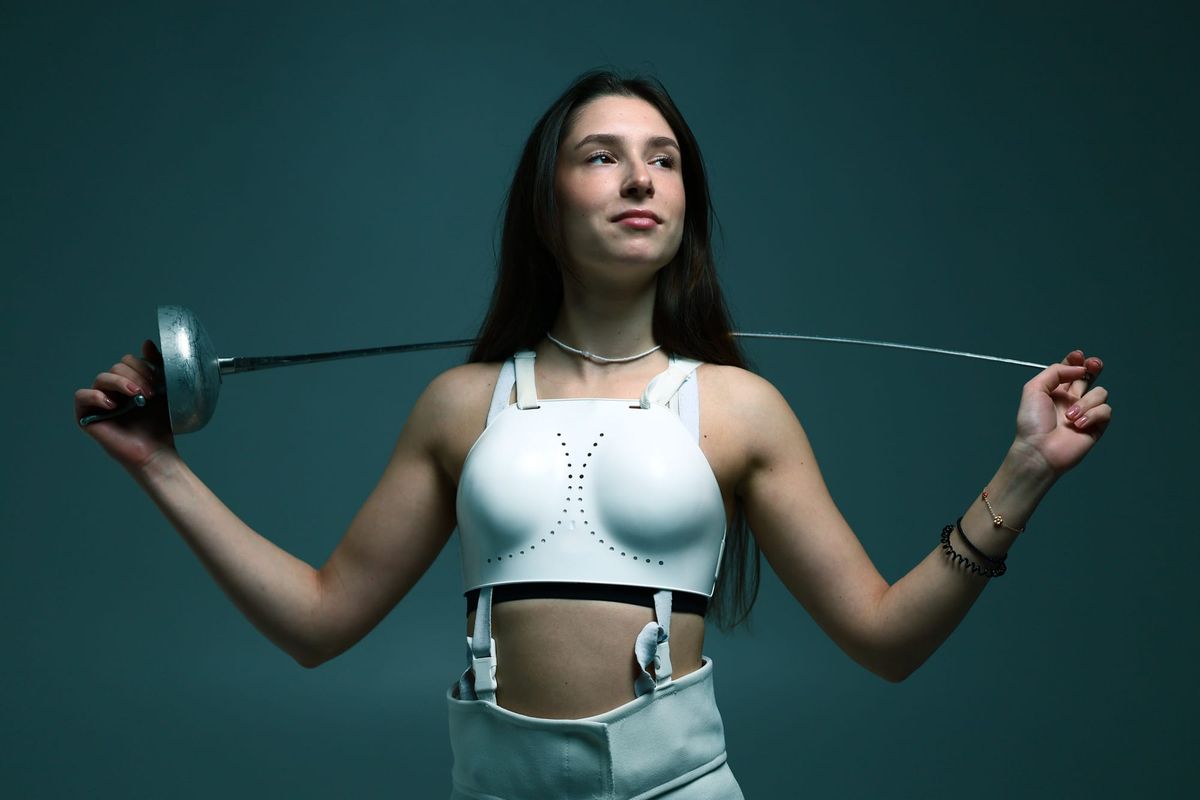
I fence; a couple of times a week, I hit other people with, and get hit by, weapons. Naturally, this requires protective gear to ensure nobody does any permanent damage to anyone else.
When I first put on a chest protector, I found it painful. Every time I swung, the top of it dug into my arms. No one else seemed to be having this problem. I mentioned it to the instructor, and he told me this can be a problem for people with large breasts.
For most people, the chest protector sits flush with the rest of their body, or close enough that it doesn't cause any issues. For those of us with big breasts, it protrudes, causing pain with every swing.
There are chest protectors designed for large breasts, known unaffectionately as "boob plates", which have protrusions in the plastic for breasts to fit into. These... suck. Because of the way they curve inwards between the breasts, any blow to the chest is going to have all the force of it funnelled to the centre. It can be, I am told, quite painful. I don't even want to think about the long-term damage from repeatedly having all the energy from a blow constantly directed to the same place.
This is hardly the first time equipment has been designed for men to the exclusion of everyone else. Invisible Women by Caroline Criado Perez1 is a whole book about how this is a man's world, and includes an example of utility belts for emergency services. These belts, designed to fit a male body and sit on male hips, cause back and hip issues for women after long-term usage.
I don't understand why we no one sells a chest protector that just... sticks out more, curves around the sides of the breasts, and is flat. Has no one designed it? Can they not get funding? Do they exist somewhere, but are struggling to be heard?
The Bullshit Solution
There is a sort-of solution that I think is going to work. I now own both a boob plate and a flat chest protector. The boob plate sits beneath the flat one, higher than it should be, to protect the upper chest. The flat protector sits lower, half on top of the boob plate, and protects my abdomen. Because the flat one is now lower than it should be, the edges that were digging into my arm are now too low to do that.
This does require me, and others like me, having to buy two chest protectors. Thankfully they're not too expensive, especially relative to other pieces of fencing gear, but... that's double the cost, which most other people don't have to pay.
And don't even get me started on a fencing jacket. I've been putting it off because I have to get a custom one; I cannot breathe in a jacket that fits my body, and one which fits my breasts is comically oversized everywhere else. So I have to take a lot of measurements, which I don't like doing (thankfully a friend has offered to help), and fork over an extra 20%.
Because of my biology.
Now I've finally overcome the chest protector hurdle, I'm going to do this soon.
My club has been inclusive and welcoming; there are so many queer people involved, and I love going just to hang out with people. Which makes it all the more disappointing to encounter a new, random way men are treated as the default in this world.
Yes, this is niche, and there are bigger problems in the world, but because of that, it's not widely known. This is yet another small addition to the pile of bullshit designed for the male body that doesn't work for everyone else.
1. The way Perez defines "sex" is trans and intersex exclusionary, and she doesn't talk about them or genderqueer people at all; not even a mention to say there's a lack of data on us. In this book, we do not exist. It is an interesting read, but I feel the need to add this caveat. Specifically, she defines sex as "biological characteristics that determine whether an individual is male or female - XX and XY."